
On October 1, 2026, Japan's Qualified Invoice System enters its next phase. If your Japan entity buys from suppliers that are not registered invoice issuers, the share of consumption tax it can deduct on those purchases drops from 80% to 70%. Nobody sends a notice. The cost simply shows up, a little higher, in every month's close.
If Japan is a live entity, this is a change to make. If Japan is a coming wave in your rollout, it is a localization item that is probably not on your list yet. This note explains what changed, why head office usually hears about it late, and the three things to check in S/4HANA this week.
The rule in one paragraph
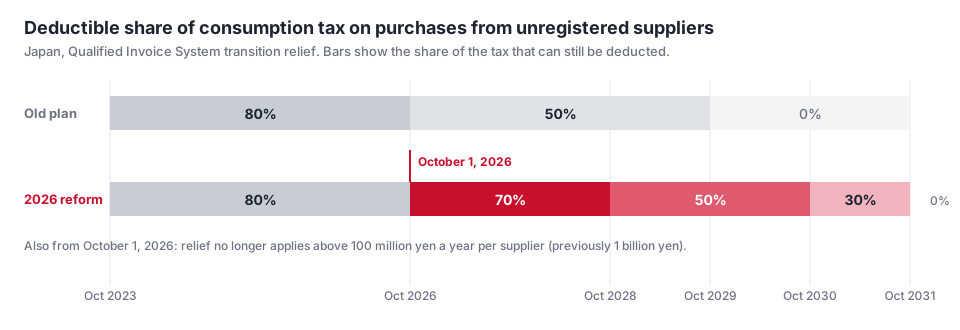
Since October 2023, a Japanese company can deduct input consumption tax only when the supplier's invoice carries a registration number (a "T" followed by 13 digits) and meets the format rules. Purchases from unregistered suppliers — often small vendors, sole proprietors, landlords — were given a transition period: 80% of the tax could still be deducted until September 30, 2026. The original plan was a drop to 50% from October 2026 and zero from October 2029. The 2026 tax reform softened the slope and stretched it by two years: 70% from October 1, 2026, 50% from October 1, 2028, 30% from October 1, 2030, and zero from October 1, 2031. One more change arrives on the same day: the transition relief no longer applies to purchases from a single unregistered supplier above 100 million yen a year, down from 1 billion yen.
Why head office hears about it late
In most Japan subsidiaries, the accounting team handled the 2023 start well. They collected registration numbers, adjusted invoice templates and moved on. The step-down in 2026 is quieter. It changes a percentage, not a process, so it rarely reaches the monthly report to head office as an agenda item. It appears later as a slightly worse tax line that someone has to explain. And because the schedule was rewritten this year, some teams are still working from the old 80-50-0 plan.
Three things to check in SAP this week
1. Is the supplier's registration status in the business partner master?
If the registration number is only on the paper invoice, the system cannot tell a registered supplier from an unregistered one. Check whether the number is stored on the business partner (commonly in the tax number fields) and whether someone owns keeping it current.
2. Do your tax codes separate the 80% and 70% cases?
Many Japan implementations created a dedicated input tax code for unregistered suppliers in 2023, set to 80% deductible. That code now needs a 70% counterpart, valid for postings dated October 1 or later, and the same exercise repeats in 2028 and 2030. Posting-date logic matters: an invoice for September services posted in October is a classic source of errors.
3. Can you see the amount?
Run a quick report of last quarter's purchases by tax code. Multiply the unregistered portion by the extra 10 points of non-deductible tax. For most subsidiaries the number is small. For some — heavy use of freelancers, small subcontractors, rented premises — it is not, and it is better to know it before the budget discussion than after.
What to ask your Japan finance team
- Which suppliers are still unregistered, and how much do we buy from them per year?
- Has the tax code for unregistered purchases been split for October 1?
- Who updates registration status when a supplier registers or deregisters?
Three questions, one short meeting. If the answers come back clear, you are fine.
The specifics of your case depend on your contracts and your tax position; confirm them with your tax advisor. This newsletter is independent and not affiliated with SAP SE. SAP and S/4HANA are trademarks of SAP SE. I write about the parts of a Japan rollout that are hard to see from head office. If your program is heading for Japan, get in touch through the contact page.
Get the next note by email. New posts go out through SAP S/4HANA Rollout Japan on Substack.
If your program is heading for Japan and you want to talk it through, contact us.